
The Team You Want On Your Side












Jacksonville DUI Lawyer
Arrested for DUI in Duval, Clay, St. John's, or Nassau County, Florida? We Can Help.
Depending on the severity of the DUI, a driver may face fines, jail time, license suspension or revocation, community service, and/or mandatory drug and alcohol treatment. In Florida, even first-time DUI offenders face harsh penalties, including jail time, fines, and driver’s license suspension.
If you have been arrested for driving under the influence of alcohol and/or drugs, you need a Jacksonville DUI lawyer who can help you navigate the legal system and ensure that your rights are protected.
Arrested for DUI? Call (904) 474-3115 or send us a message online to get started on your defense. Your initial consultation is FREE and confidential.
What Happens When You Get a DUI in Florida?
Getting a DUI in Florida is a serious offense with significant consequences. The exact penalties will depend on the facts of your situation, such as your blood alcohol concentration (BAC) and whether you have any prior DUI convictions. In addition to the criminal penalties, you may also face civil consequences for a DUI conviction. These include increased insurance premiums, difficulty finding employment, and losing your driver's license.
If you are under arrest for DUI in Jacksonville, Florida, speaking with an experienced DUI lawyer as soon as possible is essential. A DUI attorney can help you understand your rights and options and can represent you in court.
-
“I have had the pleasure of working with First Coast Criminal Defense, and it was a wonderful experience, I would highly recommend this Firm. They are totally responsive and will walk you through each phase step by step!”- Vincent
-
“First Coast Criminal Defense have been absolutely marvelous”- Jeremy
-
“I will be referring any and every one I know to this law firm.”- Dime
-
“I put my confidence in this company and I have zero regrets.”- Robin
Exclusively Dedicated to Criminal Defense
Reputation Built on Results. Relationships Built on Trust
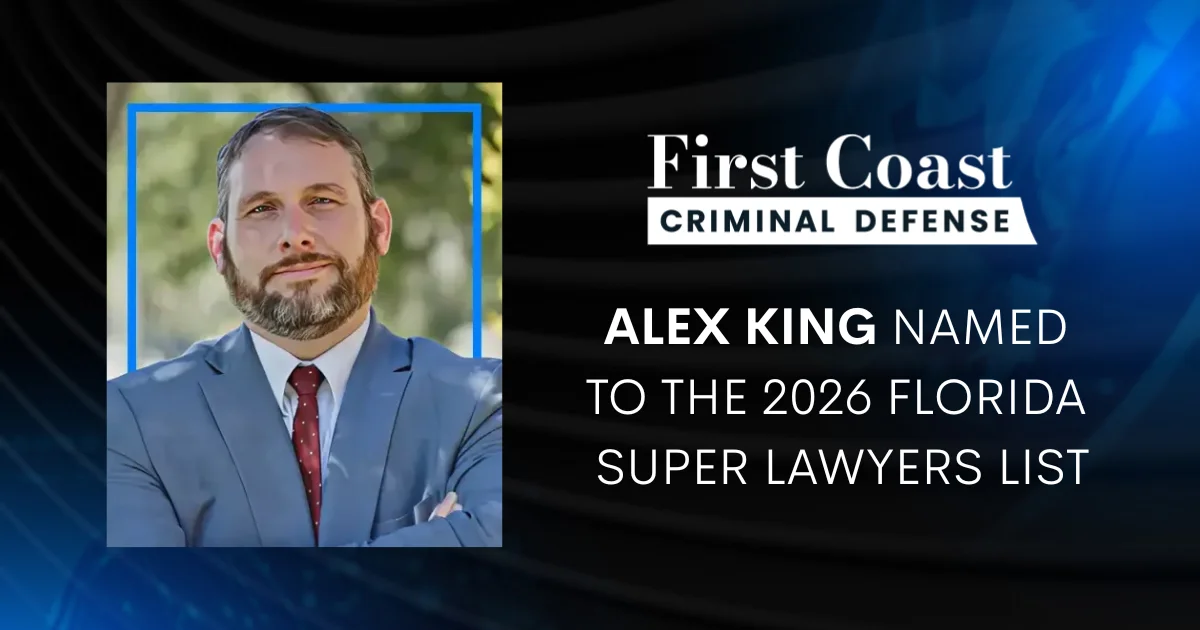
If you're facing serious charges and need someone who’s earned their stripes on both sides of the courtroom, hire Alex King. A Jacksonville native, National Merit Scholar, and top-of-his-class graduate from the University of Florida, Alex combines elite academic credentials with real-world courtroom grit. As a former DUI Unit Chief and award-winning prosecutor recognized by MADD, he brings unmatched experience handling complex cases. Now a fierce defender of clients’ rights, Alex has successfully represented high-profile professionals in everything from DUIs to international fraud. He doesn’t just know the system, he’s mastered it.

Our Areas of Practice
Exclusively Dedicated to Criminal Defense Cases





FAQ: Answers to Common DUI Questions
Most people who are arrested for or charged with DUI in Florida have a number of questions and concerns. At First Coast Criminal Defense, we understand that you need answers. Take a look at our frequently asked questions to learn more about your rights, your options, and what to expect from the DUI process in Florida.
-
Fines for DUI in Florida range depending on the circumstances surrounding your arrest. That being said, you can expect to pay:
- First-time offense: $500 up to $1,000 in fines
- Second or subsequent conviction: $1,000 to $4,000 in fines
-
The penalties for DUI in Florida increase with each subsequent conviction. To be convicted of a second DUI offense, your prior offense must have occurred within the past five years (with some exceptions). For a third offense, your prior two convictions must have occurred within the past 10 years (again, with some exceptions).
-
While technically you can refuse a breathalyzer test in Florida, doing so comes with serious repercussions. Under Florida’s implied consent laws, you consent to chemical tests (breath, blood, urine) for the purpose of evaluating your BAC when you are pulled over on suspicion of DUI. Refusing a breath test or any other chemical test will result in the automatic one-year suspension of your driver's license, plus an additional 18-month suspension for subsequent refusals. Additionally, if you refuse a breathalyzer or another chemical test, the prosecution can use this against you during your DUI trial and may try to claim that this proves your guilt.
-
No, a refusal to take a breathalyzer test is not the same as a DUI (Driving Under the Influence) charge in Florida. However, refusing to submit to a breathalyzer test can have legal consequences related to your driver's license and may impact your DUI situation. In Florida, if you refuse to take a breathalyzer test when requested by law enforcement during a traffic stop, your driver's license will be immediately suspended for a period of 1 year for a first offense, and subsequent refusals may result in longer suspensions. It's important to note that this administrative license suspension is separate from any criminal charges related to DUI.
While refusing the breathalyzer test does not automatically mean you will be charged with a DUI, it can make it more challenging to defend against DUI charges. Refusing the test does not provide evidence of your BAC, which may be used by the prosecution to build their case. However, the prosecution can still pursue DUI charges based on other evidence such as observations of impairment, field sobriety tests, witness testimony, or other factors.
-
In Florida, if you refuse to submit to a breathalyzer test, your license will be immediately suspended for one year (18 months if your license has been previously suspended for a DUI). Here are some general steps to potentially get your license back after refusing a breathalyzer in Florida:
- Serve the Suspension Period: Wait out the revocation period of 1 year (or 18 months if applicable) during which your license is suspended.
- Complete DUI Education Program: You may be required to complete a DUI education program or treatment program as part of the reinstatement process.
- Retake Required Tests: Once the suspension period is over, you will need to retake all the necessary tests, including the written test and driving test, as required for license reinstatement.
- Apply for License Reinstatement: Submit an application for license reinstatement to the Florida Department of Highway Safety and Motor Vehicles (DHSMV). This typically involves completing and submitting the appropriate forms, paying any required fees, and providing any necessary documentation.
- Attend a Hearing (if applicable): Depending on the circumstances, you may need to attend a formal review hearing with the DHSMV to appeal for license reinstatement.
- Comply with Any Additional Requirements: The DHSMV may have additional requirements for license reinstatement, such as obtaining an SR-22 insurance certificate or completing community service. Make sure to fulfill all the necessary conditions.
-
If you find yourself facing a DUI charge in Florida, you may be wondering if there is any way to get out of the charges you face. Fortunately, there are several legal defenses that you can use in Florida DUI situations. One common defense is challenging the initial traffic stop itself. You may be able to argue that the police had no reasonable cause to pull you over and performed an illegal search and seizure, and as such, any evidence obtained during the stop should not be admissible in court. A DUI defense lawyer in Jacksonville can review the facts of your situation and determine whether this is a viable option for dismissal or reduction of your charges.
You may also challenge any field sobriety tests administered during your arrest. These tests are subjective by nature and often open to interpretation from the police officer and the court. An attorney can assess the evidence to determine if any of these tests were administered or interpreted incorrectly or if other factors may have affected your performance. Finally, you could challenge any results from the breathalyzer or blood tests taken during your arrest. Breathalyzers are known to be inaccurate if not maintained or calibrated properly or administered correctly by a certified technician. Similarly, certain medications or medical conditions can affect the accuracy of blood test readings as well. A skilled DUI attorney can thoroughly investigate how the devices were handled and how law enforcement officials conducted the tests to get your charges dismissed or reduced.
It's important to remember that fighting a DUI charge is never easy. In order to have the best chance at success, it is recommended to work with an experienced DUI lawyer who understands local and state laws, has handled DUI situations similar to yours, and can review the facts of your case and help you develop a strategy for success. Your attorney can be invaluable in helping you get out of a DUI charge in Florida.
-
The cost of a DUI lawyer in Florida will depend on the complexity of the situation and the attorney’s experience and reputation. Generally speaking, DUI lawyers in Florida charge an hourly rate and may also require a retainer fee. At First Coast Criminal Defense, our Jacksonville DUI lawyers offer a free initial consultation to discuss your situation and determine the best course of action.
-
The length of a DUI situation in Florida will depend on various factors, including the complexity of the situation, the availability of evidence, and the willingness of the parties involved to reach a resolution. In some cases, a DUI situation can be resolved in a matter of weeks or months. In other cases, it may take longer to reach a resolution. Each situation's timeline is subject to additional scrutiny and potential extensions based on state-specific legal protocols or procedural holds—understanding these nuances and preparing for varied timelines from the start ensures less unexpected stress and more efficient time management during the legal process.
-
Blood Alcohol Content (BAC) is a measurement of the amount of alcohol present in a person's bloodstream. It is typically expressed as a percentage that reflects the grams of alcohol per 100 milliliters of blood. For example, a BAC of 0.08% means that there are 0.08 grams of alcohol for every 100 milliliters of blood.
BAC is used as a standard measure to determine levels of intoxication and is a key factor in legal definitions of impairment, particularly in cases involving driving under the influence (DUI) or driving while intoxicated (DWI). In most jurisdictions in the United States, a BAC of 0.08% or higher is considered illegal for operating a motor vehicle, although lower thresholds may apply for certain drivers, such as those under the legal drinking age or commercial drivers.
Several factors influence a person's BAC, including:
- The amount of alcohol consumed: More alcohol leads to a higher BAC.
- Body weight and composition: People with more body mass generally have a lower BAC after consuming the same amount of alcohol as someone with less body mass.
- Gender: Women often reach higher BAC levels than men after consuming the same amount of alcohol, partly due to differences in body water content and metabolism.
- Rate of consumption: Drinking alcohol quickly can lead to a higher BAC compared to drinking the same amount over a longer period.
- Food intake: Eating before or while drinking can slow the absorption of alcohol into the bloodstream, resulting in a lower BAC.
Law enforcement typically measures BAC using breath, blood, or urine tests. Breathalyzer devices are commonly used in roadside tests to estimate a driver's BAC based on the amount of alcohol in their breath. Blood tests are more accurate and are often used in medical or legal settings.
-
In the state of Florida, the legal limit for alcohol in a person’s system (also known as BAC) is .08%. This legal limit also applies to drivers who hold a commercial driver's license (CDL) and those under 21 years of age. For commercial drivers, the legal BAC limit is set at .04%. A conviction for driving with a BAC above this level could result in multiple penalties: suspension or revocation of both their CDL and personal driver's license, installation of an ignition interlock device on their vehicle, and potential jail time. Those under 21 years of age are subject to Zero Tolerance laws including a zero-tolerance policy for operating a motor vehicle with a BAC of at least .02%. The penalties for being found guilty of violating this policy can include suspension or revocation of their license, fines, and other consequences.
-
An ignition interlock device, or IID, is essentially a breathalyzer. If ordered by a judge, the IID will be installed on your vehicle and you will be required to blow into it to test your BAC before being able to turn your vehicle on. If the IID measures your BAC at or above the legal limit, you will not be able to start or operate your car. Ignition interlock devices are a common legal measure for repeat offenders, ensuring they do not operate a vehicle while impaired. These devices often require regular calibration and maintenance checks, typically overseen by a certified provider. For many, this device serves as a crucial step toward regaining full driving privileges and demonstrates a commitment to responsible driving habits post-conviction.
-
The Florida DHSMV allows you to request a formal or informal hearing to challenge your driver’s license suspension after a DUI arrest. It is crucial that you act quickly if you wish to challenge the automatic suspension of your driver’s license, as you only have 10 days from the date of your DUI arrest/citation to do so.
Your request for an informal or formal license suspension hearing must be made in writing and must include the following information:
- Your name, birth date, driver’s license number, and address
- The date that you received notice of your driver’s license suspension
- The county where you received notice of your driver’s license suspension
This request must be filed with the proper county clerk within 10 calendar days. If you request an informal hearing, you can submit materials supporting your belief that your driver’s license should not be suspended. The hearing officer will weigh these materials against the evidence provided by the arresting officer and will decide on whether or not to uphold your driver’s license suspension or reinstate your driving privileges. In a formal hearing, however, you and/or your attorney are permitted to provide testimony, including witness testimony, and other evidence to support your position. Though it is separate from the criminal DUI process, a formal license suspension hearing can be helpful for gathering evidence that may also be useful in your criminal DUI trial.
-
Yes, you can continue driving for the first 10 days after being arrested/cited for DUI on the temporary driving permit issued by the arresting officer at the scene. If, however, your license is suspended, it is not only illegal to continue driving but also highly ill-advised. You face even harsher penalties if you are arrested for driving on a suspended license. If you wish to appeal the Florida DHSMV’s decision to uphold the suspension of your license, you may do so.
-
If you are pulled over for DUI in Florida and you fail the breathalyzer test (or another chemical test, such as a blood test), meaning your BAC is 0.08% or higher, you will be arrested and taken to jail for a period of at least 8 hours. Following this, you face additional jail time if you are ultimately convicted for DUI.
The amount of jail time you face depends on a variety of factors, including:
- Your BAC
- Whether or not there was a minor present in your vehicle
- If you were involved in a crash that resulted in injuries and/or fatalities
Generally speaking, without additional factors such as these, you face jail time according to the following measures:
- BAC was between 0.08% and 0.15%: Up to 6 months in jail
- BAC was higher than 0.15%: Up to 9 to 12 months in jail
- Minor in the vehicle: Up to 9 to 12 months in jail
The only way to possibly avoid this jail time is to contact an experienced DUI defense lawyer who can fight to reduce your charges, have your charges dismissed, or pursue alternative penalties on your behalf.
-
Yes, if you are convicted of DUI in Florida, your driver’s license will be suspended. The length of the suspension will depend on a number of factors—including whether you have prior DUI convictions in the past 5 to 10 years, your BAC when arrested, and more—but, in general, you face losing your license for anywhere from 180 days to 6 months or up to 10 years for the most serious offense. Additionally, immediately upon being arrested for DUI, your license will be revoked, and you will be issued a temporary driving permit valid for 10 days. If you wish to challenge your driver’s license suspension, you must request a formal administrative hearing with the Florida Department of Highway Safety and Motor Vehicles (FDHSMV) within 10 days. If you fail to do so, your license will be suspended on the 11th day after your arrest.